Friday, April 24
Friday, April 10


Sunday, March 29
USGS records hybrid seismic event at Kilauea volcano
March 26, 2009 - Hawaii Volcanoes National Park, Hawaii
VIDEO: USGS Hawaiian Volcano Observatory
The Hawaiian Volcano Observatory on the Big Island of Hawaii has released video of a robust brown plume associated with a "hybrid seismic event" on the summit of Kilauea at 11:03 am.
The HVO website says brown plumes like this one have appeared occasionally throughout the past year of eruptive activity at the summit, and are often associated with rockfalls.
According to the HVO daily update, Wednesday's activity started with at least two more dusty plumes followed by a larger collapse at 11:03 am and a large, dense, brown plume; there were several more brown plumes over the next two hours before settling to a white plume moving southwest from the crater.
VIDEO: USGS Hawaiian Volcano Observatory
|


The HVO website says brown plumes like this one have appeared occasionally throughout the past year of eruptive activity at the summit, and are often associated with rockfalls.
According to the HVO daily update, Wednesday's activity started with at least two more dusty plumes followed by a larger collapse at 11:03 am and a large, dense, brown plume; there were several more brown plumes over the next two hours before settling to a white plume moving southwest from the crater.


Wednesday, March 25
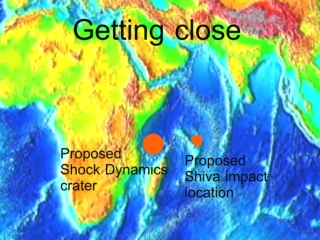
Shock Dynamics
A new geology theory featuring impact-powered rapid
continental drift as an alternative to plate tectonics.

continental drift as an alternative to plate tectonics.
Saturday, March 21
Geologists spot steam plume over Redoubt
ANCHORAGE, Alaska — Alaska's Mount Redoubt is again drawing attention because of its potential for an explosive volcano.
Geologists at the Alaska Volcano Observatory say there's a steam plume rising about 1,000 feet above the mountain roughly 100 miles southwest of Anchorage. No explosive or ash activity such as occurred last Sunday has been identified and the observatory has not raised the warning level for the mountain.
Thursday, March 19
Quake Triggers Pacific Tsunami Alert
A tsunami alert issued after a major 7.9 magnitude earthquake struck off the Tonga islands region has been cancelled.
Tsunami alert triggered following earthquake and volcano eruption
The quake occured about 130 miles southeast of Nuku'alofa, Tonga, the US National Weather Service's Pacific Tsunami Warning Centre said.
A tsunami warning was issued for Tonga, Niue, Kermadec Islands, American Samoa and Fiji.
"Sea level readings indicate a tsunami was generated," the centre said in a bulletin.
Wednesday, March 11
Monday, March 9

Saturday, March 7
What is this object near Ursa Major?

Mr. Teles, from Serra dos Candeeiros (Portugal) send me this photograph taken last monday (2009 - 2rd March).
Near 23:00 PM, at zenital position, this glowing object stays in that position for several minutes. I looked for some nightsky charts from that day and didn't find anything. The Big Dipper (Ursa Major) is under the object. Could be comet Lulin in those coordinates?
Tuesday, February 24

Sunday, February 22
Bubbles of warming, beneath the ice
As permafrost thaws in the Arctic, huge pockets of methane -- a potent greenhouse gas -- could be released into the atmosphere. Experts are only beginning to understand how disastrous that could be.
Methane (CH4) has at least 20 times the heat-trapping effect of an equivalent amount of carbon dioxide (CO2). As warmer air thaws Arctic soils, as much as 55 billion metric tons of methane could be released from beneath Siberian lakes alone, according to Walter’s research. That would amount to 10 times the amount currently in the atmosphere.
At 32, Walter, an aquatic ecologist, is a rising star among the thousands of scientists who are struggling to map, measure and predict climate change. Parts of her doctoral dissertation on Siberian lakes were published in three prestigious journals in 2007: Science, Nature and Philosophical Transactions of the Royal Society.
According to one of her studies, methane emissions from Arctic lakes were a major contributor to a period of global warming more than 11,000 years ago.
"It happened on a large scale in the past, and it could happen on a large scale in the future," says Walter, who refers to potential methane emissions as "a time bomb."
Subscribe to:
Posts (Atom)